
Introduction
Color vision is a fundamental aspect of human perception, influencing everything from art and design to safety and medical diagnostics. Among the various tools used to assess color vision, the Munsell Hue 100 Test is one of the most reliable and widely used. This test, developed based on the Munsell Color System, evaluates an individual’s ability to distinguish subtle differences in hue, helping to detect color deficiencies and assess color discrimination skills. In this article, we will explore the Munsell Hue 100 Test, its purpose, methodology, applications, and significance.
What is the Munsell Hue 100 Test?
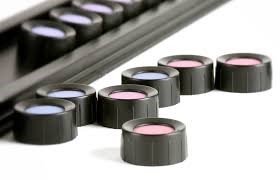
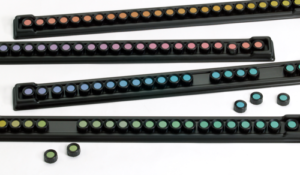
The Munsell Hue 100 Test is a color vision test designed to measure an individual’s ability to perceive and differentiate hues accurately. It consists of four trays containing a series of colored caps that need to be arranged in a specific order based on their hue progression. The test is widely used in various fields, including ophthalmology, color science, design, and manufacturing industries where color accuracy is critical.
 History and Development
The Munsell Hue 100 Test is based on the Munsell Color System, developed by Albert H. Munsell in the early 20th century. The system organizes colors based on three properties:
- Hue: The color type (e.g., red, blue, green, etc.).
- Value: The lightness or darkness of a color.
- Chroma: The intensity or purity of a color.
Munsell’s system was developed to provide a standardized approach to color classification, which later became the foundation for various color-related studies and applications, including color vision testing.
How the Munsell Hue 100 Test Works
The test consists of 85 color caps, arranged in four separate trays. Each tray contains a fixed starting and ending color, with 21 to 22 moveable caps in between. The participant’s task is to arrange these caps in a smooth, continuous gradient from one fixed color to the next.
Test Procedure
- Setup: The test is conducted under controlled lighting conditions to avoid color distortions.
- Arrangement: The participant arranges the caps in each tray based on their perception of color gradation.
- Evaluation: The arrangement is then analyzed to identify errors, which can indicate color vision deficiencies.
- Scoring: The test results are quantified, and a lower score indicates better color discrimination ability, while a higher score suggests difficulty in differentiating hues.
 Interpreting Test Results
The scoring system of the Munsell Hue 100 Test is designed to identify both normal and defective color vision. The number and type of errors determine the level of color discrimination ability:
- 0–4 errors: Excellent color discrimination
- 5–16 errors: Good color discrimination
- 17–40 errors: Moderate color discrimination
- 41+ errors: Poor color discrimination
Certain error patterns may indicate color vision deficiencies, such as:
- Red-green deficiency (protanomaly, deuteranomaly)
- Blue-yellow deficiency (tritanomaly)
- Generalized color discrimination loss (often due to aging or eye diseases)
 For Medical and Ophthalmological Use
The test is commonly used in eye care and medical diagnostics to detect color vision deficiencies. Conditions such as color blindness, cataracts, and age-related macular degeneration can impact color discrimination ability, making this test a valuable diagnostic tool.
Industrial and Professional Applications
Many industries require precise color differentiation, making the Munsell Hue 100 Test essential for professionals in:
- Graphic Design & Printing: Ensuring accurate color reproduction in digital and print media.
- Textile & Fashion Industry: Assessing fabric dyeing and color consistency.
- Automotive & Paint Manufacturing: Checking paint color quality and consistency.
- Cosmetics Industry: Evaluating product color matching.
Scientific Research and Color Studies
The test is widely used in psychology, neuroscience, and color science to study how humans perceive and process color information. Researchers use it to explore topics such as color adaptation, visual fatigue, and the effects of aging on color perception.
Factors Affecting Test Performance
Several factors can influence an individual’s performance on the Munsell Hue 100 Test:
1. Lighting Conditions
Proper lighting is crucial for accurate color perception. The test should be performed under standardized daylight or artificial lighting conditions to minimize color distortions.
2. Age and Health
Aging can affect color perception due to physiological changes in the eye, such as yellowing of the lens and reduced retinal sensitivity. Eye conditions like cataracts, glaucoma, and diabetic retinopathy may also impair color vision.
3. Genetics and Color Vision Deficiencies
Color vision deficiencies, particularly those linked to the X chromosome, can significantly impact test results. Individuals with congenital red-green color blindness typically perform poorly on the test.
4. Fatigue and Concentration
Visual fatigue and lack of concentration can lead to errors in color arrangement. It is recommended that participants take the test when they are well-rested.
Advantages of the Munsell Hue 100 Test
- High Precision: Provides a detailed assessment of color vision ability.
- Easy to Administer: Simple and does not require specialized equipment.
- Versatile Applications: Useful in various industries and research fields.
- Quantifiable Results: Generates numerical scores for easy interpretation.
Limitations of the Test
- Time-Consuming: Can take up to 15–30 minutes to complete.
- Subjectivity: Results may be influenced by environmental factors and participant fatigue.
- Not a Definitive Diagnosis: While useful for screening, the test should be supplemented with medical evaluations for comprehensive diagnosis.
Conclusion
The Munsell Hue 100 Test is a highly effective tool for assessing color discrimination and detecting vision deficiencies. It has significant applications across medical, industrial, and scientific fields, helping professionals ensure color accuracy and identify visual impairments. Whether used for professional assessments or personal interest, this test remains a gold standard in the field of color vision evaluation.