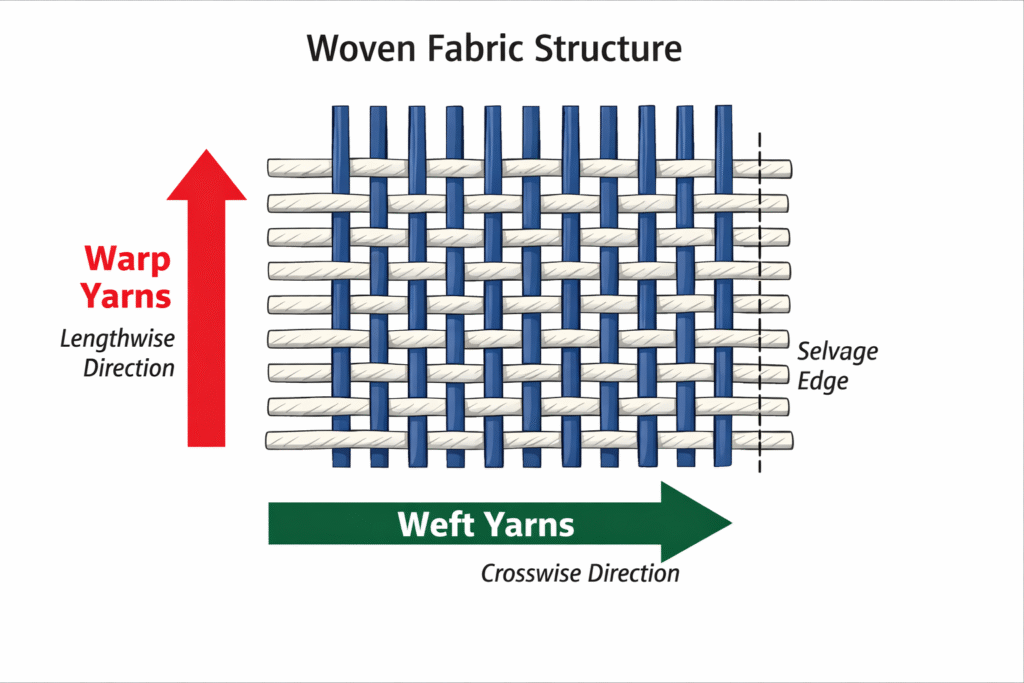
Woven fabrics form the backbone of the global textile industry, from everyday apparel to technical and industrial textiles. At the heart of every woven fabric lies a simple yet highly engineered structure created by the interlacement of warp yarns and weft yarns. Understanding the difference between warp and weft is essential for textile students, professionals, designers, and manufacturers alike, as these two yarn systems directly influence fabric strength, appearance, performance, and end-use.
This article provides an in-depth comparison of warp vs weft yarns in woven fabrics, covering their definitions, characteristics, manufacturing roles, and impact on fabric properties.
What Are Warp Yarns?
Warp yarns are the set of yarns that run lengthwise in a woven fabric, parallel to the fabric selvage. These yarns are held under tension on the loom during weaving and form the backbone of the fabric structure.
Key Characteristics of Warp Yarns
Warp yarns are engineered to withstand significant mechanical stress during weaving. As they are constantly stretched, lifted, and lowered, they must possess higher strength and abrasion resistance.
Key features include:
Oriented in the fabric length direction
Usually stronger and smoother than weft yarns
Subjected to high tension during weaving
Typically sized (coated with sizing chemicals) to reduce breakage
Contribute significantly to fabric strength and dimensional stability
Because of these requirements, warp yarns often use higher twist levels or stronger fiber blends.
What Are Weft Yarns?
Weft yarns (also called filling yarns or pick yarns) are inserted horizontally, perpendicular to the warp yarns. Unlike warp yarns, weft yarns are not held under constant tension and are inserted across the fabric width using a shuttle, rapier, air jet, or water jet.
Key Characteristics of Weft Yarns
Weft yarns play a major role in fabric aesthetics and comfort. Since they experience less mechanical stress during weaving, they can be softer and bulkier.
Typical features include:
Oriented in the fabric width direction
Lower tension compared to warp yarns
Generally softer, thicker, and less twisted
Rarely sized
Strongly influence fabric handle, drape, and appearance
Weft yarns allow designers more freedom in selecting yarn types, colors, and textures.
Warp vs Weft: Structural Differences
The structural differences between warp and weft yarns define how woven fabrics behave in real-life use.
Direction and Orientation
Warp yarns run parallel to the selvage and determine fabric length
Weft yarns run from one selvage to the other and determine fabric width
This orientation affects how fabric stretches, shrinks, and reacts to stress.
Differences in Yarn Preparation
Warp Yarn Preparation
Warp yarns undergo extensive preparation before weaving:
Warping – arranging yarns in parallel order
Sizing – applying protective chemicals (starch, PVA, CMC)
Beaming – winding warp yarns onto the loom beam
Sizing improves:
Tensile strength
Abrasion resistance
Weaving efficiency
Weft Yarn Preparation
Weft yarns require minimal preparation:
Wound onto packages or pirns
No sizing in most cases
Focus on uniformity and appearance rather than strength
Impact on Fabric Properties
Strength and Durability
Warp yarns contribute more to tensile strength
Weft yarns contribute to tear resistance and flexibility
Fabrics generally exhibit higher strength along the warp direction.
Fabric Appearance
Warp yarns often define fabric surface smoothness
Weft yarns influence color patterns, stripes, and textures
In many fabrics, decorative effects are achieved by changing weft yarn colors or counts.
Shrinkage Behavior
Warp yarns shrink less due to higher tension and sizing
Weft yarns shrink more, especially in natural fibers like cotton
This is why fabrics often shrink more in width than length.
Comfort and Drape
Weft yarns largely control softness and drape
Warp yarns provide structure and shape retention
Balanced fabrics carefully optimize both systems.
Warp and Weft Density (Ends and Picks)
Fabric construction is often defined by:
Ends per inch (EPI) – number of warp yarns per inch
Picks per inch (PPI) – number of weft yarns per inch
Higher EPI:
Increases fabric strength
Improves abrasion resistance
Higher PPI:
Improves cover
Enhances fabric fullness
The ratio of EPI to PPI plays a crucial role in fabric balance.
Warp vs Weft in Different Fabric Types
Plain Weave
Equal interlacement of warp and weft
Balanced appearance
Similar influence from both yarn systems
Twill Weave
Warp or weft dominance creates diagonal lines
Warp-faced twills are stronger and smoother
Weft-faced twills are softer and heavier
Satin Weave
Long warp or weft floats
Warp satin: smoother surface
Weft satin: softer drape
Common Fibers Used in Warp and Weft
Warp yarns often use:
Polyester
High-twist cotton
Blended yarns
Weft yarns often use:
Cotton
Viscose
Modal
Specialty textured yarns
This combination balances performance and comfort.
Practical Identification of Warp and Weft
In finished fabrics, warp and weft can be identified by:
Selvage direction (warp runs parallel)
Higher yarn density (usually warp)
Less stretch in warp direction
Smoother yarns in warp direction
Conclusion
The distinction between warp and weft yarns in woven fabrics goes far beyond simple orientation. Warp yarns provide strength, stability, and durability, while weft yarns enhance comfort, appearance, and design flexibility. A successful woven fabric depends on the intelligent balance between these two yarn systems.
For textile engineers, designers, and manufacturers, understanding warp and weft behavior is fundamental to fabric development, quality control, and end-use performance. Whether designing apparel, home textiles, or technical fabrics, mastering warp and weft principles leads to better, more functional woven products.